Posted on

Citrine

This sunny, happy stone is a member of the quarts family, and is basically the yellow to orange-brown variant that grows in conjunction with Amethyst.

Natural Citrine is actually rare; most gems on the market are Amethyst (purple) that has been heat-treated to turn yellow.

citrine and gold ring - goldfish jewellery design studio
“Celtic Love”. Citrine set in 9ct Gold Ring. Made by Goldfish Jewellery Design Studio

Citrine got its name from the French word for lemon: “citron”.

In Ancient times this gem was carried to ward of evil thoughts and snake bites. It is also said that if you place it in your moneybox it will attract more business, hence its nickname, ‘Merchant Stone’.

Citrine is one of the few stones that dispel negative energy, so it never needs to be energetically cleaned. In fact, this stone is excellent for alleviating depression and for brightening up those dark corners of ones self. It helps the wearer to laugh and frees the mind from negative thought.

On the physical side it is used in the treatment of thyroid, kidney and liver problems. It also aids in matters of digestion and blood circulation.

Citrine is one of the November birthstones and is well known for its calming energies. The stone also represents strength and hope, peace, prosperity, loyalty, healing and creativity.

— Reinette


Goldfish Jewellery Design Studio works with all precious metals, stones and diamonds. For further information, please contact us.
Posted on

Ruby

Symbolizing wealth, joy, love and power, the Ruby has always been cherished and desired by people throughout the world.

They are offered to Buddha in China, Krishna in India, and are closely associated with dragons in western mythology. Ancient Hindus called the stone the “King of Gems” and believed it radiated a warmth and luminosity from an internal flame.  This was linked to passion and love that emanates from the heart, making this stone a perfect gift for  lovers.

Along with Padparadscha, Ruby is a colour of Sapphire with it’s own name. Second only to the Diamond in hardness, the Ruby is ideal for the use in jewellery.

The most valuable Rubies originate from Burma, however, they are also found in Thailand, Australia, Afghanistan, Pakistan, Vietnam, India, Russia, Norway and America. Synthetic rubies were first made in 1902 by a Frenchman, Auguste Verneuil, using powdered aluminium oxide and a blowtorch.

ruby - goldfish jewellery design studio
STRAWBERRIES AND CREAM“. Rhodolite Garnet central stone with a total of 0,22ct Diamonds and eight little Rubies on the shoulders, set in 9ct White Gold. Made by Goldfish Jewellery Design Studio.

The Ruby has found a special place in our hearts and legends.

The Burmese believed it could only be found in bottomless valleys. They would toss meat into the valleys in the hope that some of the Rubies would stick to the meat and be eaten by vultures; they could then retrieve the gems by killing the vultures.

The most common beliefs are obviously those associated with love. The Ruby is meant to help us in all manners of love; this is possibly due to the bright red colour which is due to the chromium and iron content. The Ruby is also supposedly meant to stimulate sexual desires and energies.

One of the most interesting myths associated with Ruby is that when the wearer is in danger or about to become ill, the stone would become darker.

It is an amplifier of energy, both positive and negative, and can help the circulatory system, stimulate motivation and visualisation, as well as dealing with listlessness.

Some believed it to be a stone of protection, and was worn when going into battle.

Bestowing knowledge, health and wealth are also on the long list of uses for the ruby, and it is often found carved with dragons and snakes to promote the flow of money and power to the owner.

When a man wears a Ruby it is said to signify manhood, nobility and valour.

To dream of rubies is a sign that success is on the way.

This gem is also meant to chase away spirits and evil phantoms that are hanging around.

Ruby is the July birthstone and represents contentment, peace, harmony and integrity.

— Zak


Goldfish Jewellery Design Studio works with all precious metals, stones and diamonds. For further information, please contact us.

Posted on

Aquamarine

A variety of Beryl, this blue to sea-green stone’s name actually means ‘sea water’ in Latin. In the 19th century the sea- green variety was the most popular, however, today the blue colour is the most sought after Aquamarine.

Aquamarine is often confused with Topaz, but Aquamarine usually has a softer blue and lack any traces of grey. The element responsible for the stone`s lovely colour is Iron. Even though it can be found on every continent, the deposits in Brazil are the most important. Sadly some major deposits in Russia have already been mined out.

Also called the ‘Sailors Gem’, it was thought to bring courage and calmness; and was valued as a protective stone. Medieval belief was that Aquamarine would reawaken the passions of married couples.

In the Bible it is written that Aquamarine was used in the foundations of the ‘Heavenly City’. In Exodus, the high priest wore one on each shoulder.

This gem is believed to help with motion sickness, to help sooth the nerves, and aids in the healing process after trauma.

Aquamarine is the March birthstone associated with courage, loyalty and friendship; and symbolizes honesty, faithfulness and beauty.

— Reinette

Goldfish Jewellery Design Studio works with all precious metals, stones and diamonds. For further information, please contact us.

Posted on

Opal

Opal Pendant - Goldfish Jewellery Design Studio

“With the fire of carbuncle, the brilliant purple of amethyst and the sea green colour of the emerald, all shining together in incredible union”;  these are the words used by Pliny the Elder (23-79AD) in the world’s first Encyclopaedia, and possibly the best description of this beautiful gem stone.

In ancient times this precious gem was only found in Czechoslovakia, until the Spaniards returned from South America with fine specimens of Aztec Opals.

The Opal went through a stage in its history when it was believed to carry bad luck; this was due to Sir Walter Scott’s “Anne of Geierstein”, in which the heroine possesses an Opal that changes colour according to her emotions and crumbled upon her death.

A rich and intricate history, for a rich and intricate stone, the stone`s intriguing play of light and colour is due to the moisture content of the stone – which when lost, the stone loses its fire. This fact and the fascinating play of colour and light have woven numerous legends and myths into the Opal`s history.

The Greeks believed it to bestow powers of fore sight and prophecy. The Arabs believe the stone fell from the heavens in flashes of lightning. Cherished by thieves who would wrap the gem in a bay leaf to become invisible, and worn by blondes to keep the colour of their hair, the Opal really has a colourful and vibrant history.

The name Opal is derived from the Sanskrit word upala (Precious stone), the Greek word opallios (to see a colour), and the Latin word opalus (to see a change of colour).

Opal artifacts have been recovered from caves in Kenya, dating back 6000 years. Now days 95% of the opals mined come from Australia which has become synonymous with the Opal, and adopted it as one of its national symbols.

People born in October must surely be blessed to have the Opal as their birthstone.

— Zak


Goldfish Jewellery Design Studio works with all precious metals, stones and diamonds. For further information, please contact us.

Posted on

Pearls: The Tears of the Gods

Pearls are the essence of hope, faith, and the ability to make the best of the situation you are in.

It is an organic gem that is formed when an irritant (usually a grain of sand) enters a mollusc (shellfish). The oyster or mollusc coats the irritant with layers of nacre, also known as mother of pearl, until the irritant is turned into a beautiful pearl! Light reflecting from these overlapping layers of nacre creates a characteristic iridescent lustre which is also known as the “orient of the pearl”.

For thousands of years natural pearls have been harvested from the Red Sea, Persian Gulf and the Gulf of Manaar. Once believed to be the tears of the Gods, the pearl is also referred to as the “Queen Gem” (diamond being the “King Gem”). The Ancient Hindus included it as one of the five sacred gems on the magical necklace of Vishnu.

In the case of Cultured Pearls, the irritant is introduced to initiate the formation of the pearl – this is the case with most pearls on the market today as it is much more cost effective to cultivate them than it is to search the seas for oysters bearing Pearls. Freshwater Pearls occur in the rivers of Scotland, Ireland, Austria, France, Germany and Mississippi. Both Freshwater and Saltwater Pearls are cultivated in Japan.

The pearl is one of the June birthstones, and gemstone of the 3rd and 30th anniversary.

It is said that the Pearl enable us to accept love.

There is also a great myth that says Pearls are unlucky, but it simply cannot be said of the lucky grain of sand that started out as an annoyance and ended up being a beautiful gem!

— Reinette

Goldfish Jewellery Design Studio works with all precious metals, stones and diamonds. For further information, please contact us.

Posted on

Synthetic Gems and Enhancements

Ever looked at grandma’s ring with the large red or blue coloured gemstone mounted in the center, and wondered how much it is really worth? Chances are in terms of monetary value; it is probably not worth much.

The majority of pieces produced during the 1930s contained synthetic stones. As we developed and progressed into the industrial era, the price to reproduce a synthetic gemstone became far more reasonably priced and extremely popular – thus almost everyone from that era had at least one ring containing synthetic gems.

Natural amethyst and rock crystal quartz crystals (left) and synthetic amethyst and synthetic rock crystal quartz crystal (right).  Image and text supplied by GIA

People have tried to create gemstones for many years, however, the process only began to become successful around the 1800s. In 1877, Edmond Fremy, a French chemist grew the first synthetic gem quality stones of reasonable size.

In 1900, August Verneuil, devised the technique to create Ruby – this basic method is still used to grow crystals today. The technique involves dropping powdered raw materials into a furnace at temperatures in excess of 2000°C. The materials melt and form droplets which are drawn out of the furnace as “boules”. From this roughly cylindrical shape the gemstone is then faceted in the same manner as natural gems are.

synthetic gems
Synthetic ruby can be produced via flux growth processes (crystal and cut stone on left), and flame fusion (boule and cut stone on right).  Image and text supplied by GIA

There are obviously thousands of different colours and shapes available and they are mostly distinguished from natural gemstone by the shape of the “growth lines” and the type and nature of the inclusions present in the gem.

Enhancements

There are other sneaky and tricky things that humans have discovered that they can do to natural gemstones in order to make them more attractive to our senses.

Some diamonds are made in high pressure high temperature environments, including this collection of synthetic diamonds in a variety of colors. Image and text supplied by GIA

The first and most common form of enhancement performed on gems today is known as irradiation and can be in several forms, from the Indian’s leaving Carnelian out in the sun to create a more orange colour, to modern gemmologists exposing gems to all sorts of radioactive materials (this process takes thousands of years to occur in nature).

Gems can also be dyed if they are porous. Some gemstone colours become more intense and even change colour when heated to specific temperature.

Oils are another enhancements that have been used for thousands of years to fill visible inclusions and slight blemishes; this technique is most common with emeralds.

Some stones are even bonded together to create the impression of pleochroism; like the garnet topped doublet which consists of a coloured glass base bonded to a thin top section of garnet. Pleochroic gemstones refers to gems that appear to have different colors or depth of color when viewed from different angles

Some purists feel it is not good practice to use or supply gemstones that have been enhanced or man made.

I personally feel that jewellery is an extremely personnel thing and people are very sentimental about their little treasures, some of which are worth tens of thousands of rands. Wear what you like and want to wear, if it’s beautiful or means something to you, no amount of money can replace that value.

— Zak


Goldfish Jewellery Design Studio works with all precious metals, stones and diamonds. For further information, please contact us.


Posted on

Alexandrite

Alexandrite

Ladies and gentlemen, I present to you the rarest gem of all: Alexandrite. Rarer than Sapphire, Ruby, Emerald, Diamond and Tanzanite, it is extremely difficult to come by. And even if you do manage to track one down, you will pay through your nose!

What sets this beauty apart is its colour changing abilities, it has been referred to as ‘an Emerald by day and a Ruby by night’.  Alexandrite is a Chrysoberyl which contains not only titanium and iron, but also chrome, which accounts for the spectacular colour change. The stone goes from green in daylight to purplish-red in artificial light. This does vary depending on where it was mined, but the most sought after stones are from Russian descent.

Alexandrite was discovered in 1830 in the Emerald mines in the southern part of Russia’s Ural Mountains. It was named after Czar Alexander II, as it was discovered on his birthday, and was highly prised by Russian aristocrats and royalty as it displayed their national military colours, green and red. At first it was exclusive to the Russian ‘richest’ as it was the only source for more than 90 years, however, small deposits were found on the island of Sri Lanka but the quality wasn’t nearly as good as the Russian stones.

In the mid-1980’s a relatively large strike of Alexandrite was made in the Brazilian state of Minas Gerais at Hematita. Chaos ensued… when the news leaked out, 3000 ‘garimpeiros’ (independent prospectors) descended on the small valley and began digging. This valley is only 500 feet wide and 650 feet long! It is understandable that the government gave the order to shut down after only 12 weeks, with an average of one death by gunshot per week.

By then the area was basically mined out. It is estimated that the total (cut) weight mined there, was only 150 000 carats, sound like a lot? Not next to the 100 million carats of diamonds mined every year…

Since then mining has resumed in Hematita, but very sporadic. Limited amounts have been coming out of Russia since the fall of the Soviet system, but these stones generally have owners even before they are mined.

Alexandrite is the birthstone for June, along with Pearl and Moonstone.

If you are indeed the lucky owner of such a gem, it is said to give clarity of thought in difficult situations and will support creativity and inspire imagination. Just the kind of stone I would like to possess!

— Reinette

Goldfish Jewellery Design Studio works with all precious metals, stones and diamonds. For further information, please contact us.


Image credit: By Original uploader was User: at en.wikipedia – Photographed by David Weinberg for Alexandrite.net and released to the public domain. Alexandrite.net contributors. Step Cut Alexandrite Cushion, 26.75 cts. In Alexandrite.net, Tsarstone collectors guide. December 07, 2006, 16:42 UTC. Available at: http://www.alexandrite.net/viewpage.html?id=ALX-001-00001. Accessed February 26, 2007., CC BY-SA 3.0, Link

Posted on

Peridot – Cleopatra`s Favourite Stone

peridot - goldfish jewellery design studio

The Peridot

Also known as Olivine, this gem`s colour ranges from yellow-green through to bottle green.

Until the 19th century, the origin of the Peridot was the subject of much speculation. One such theory was that the gem was found only in meteorites, but early this century it was proven that they actually originated on the island of Zebirget on the Egyptian shore of the Red Sea where it has been mined for 3500 years.

The Peridot now occurs in Egypt, China, Burma, Brazil, Hawaii, Arizona, Australia, South Africa and Norway.

Apart from being cherished for its beauty, it has also been coveted for its healing properties.

The gem is believed to stimulate the mind, relieve stress and open new doors of opportunities and abundance, while banishing lethargy and laziness. It can also help to heal a “bruised” ego by controlling anger and jealousy. It is a good antitoxin stone, cleaning most organs and glands, acting as a “tonic” to strengthen and regenerate the body.

Peridot has been used in the treatment of ulcers and disorders of the heart, lungs, spleen and intestinal tract. It has also been used in the birthing process, thought to stimulate contractions and facilitate the opening of the birth canal.

Peridot is one of the birthstones of September, and  symbolizes married happiness.

— Zak

Sterling Silver Small Protea Peridot Ring


Goldfish Jewellery Design Studio works with all precious metals, stones and diamonds. For further information, please contact us.


Posted on

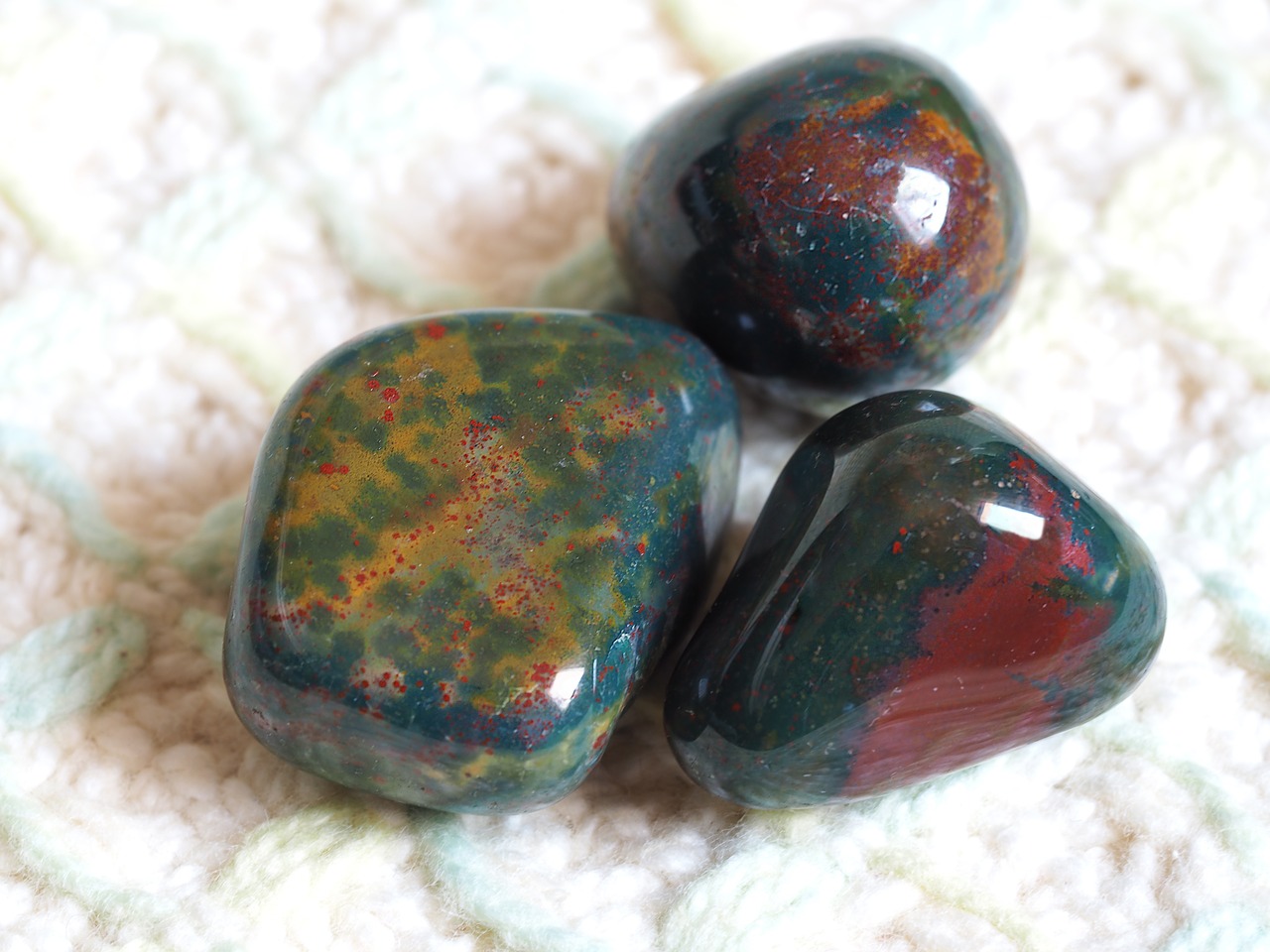
Bloodstone

bloodstone

Bloodstone is a dark green stone with red flecks. It is a form of silica quarts, also known as green Chalcedony. Chalcedony is actually a group of tiny quartz crystals that grow in masses/lumps. Plasma and Heliotrope are the two variations; Plasma is very deep opaque green with little or no red flecks and may even have yellowish spots. Heliotrope is a slightly translucent, lighter green and has red in it.

As with many gemstones, Bloodstone was treasured by the ancients. The Christian religion had a close connection with this gem as it was said to represent the blood of Christ. The legend of Bloodstone says that it formed when a drop of Christ’s blood fell on some Jasper at the foot of the cross. A traditional amulet would have the head of Christ positioned on Bloodstone in such a way that the red flecks look like blood.

During the middle-ages, Bloodstone was believed to have healing powers; the stone was crushed and mixed with egg whites and honey to cure tumours and to stop bleeding. Alchemists used it to cure blood poisoning or to draw out poison from snakebites. A Franciscan Friar gave the Mexican Indians pieces of Bloodstone during the 1576 plague to stop their haemorrhaging.

On a metaphysical level, Bloodstone is said to heal all blood ailments. It also symbolises the connection between the red lifeblood of animals and the green plant world. For meditation, this gem is excellent as it helps to align chakras and smoothes energy flow.

Bloodstone is the birthstone for March.

— Reinette

Goldfish Jewellery Design Studio works with all precious metals, stones and diamonds. For further information, please contact us.


Posted on

The Hope Diamond

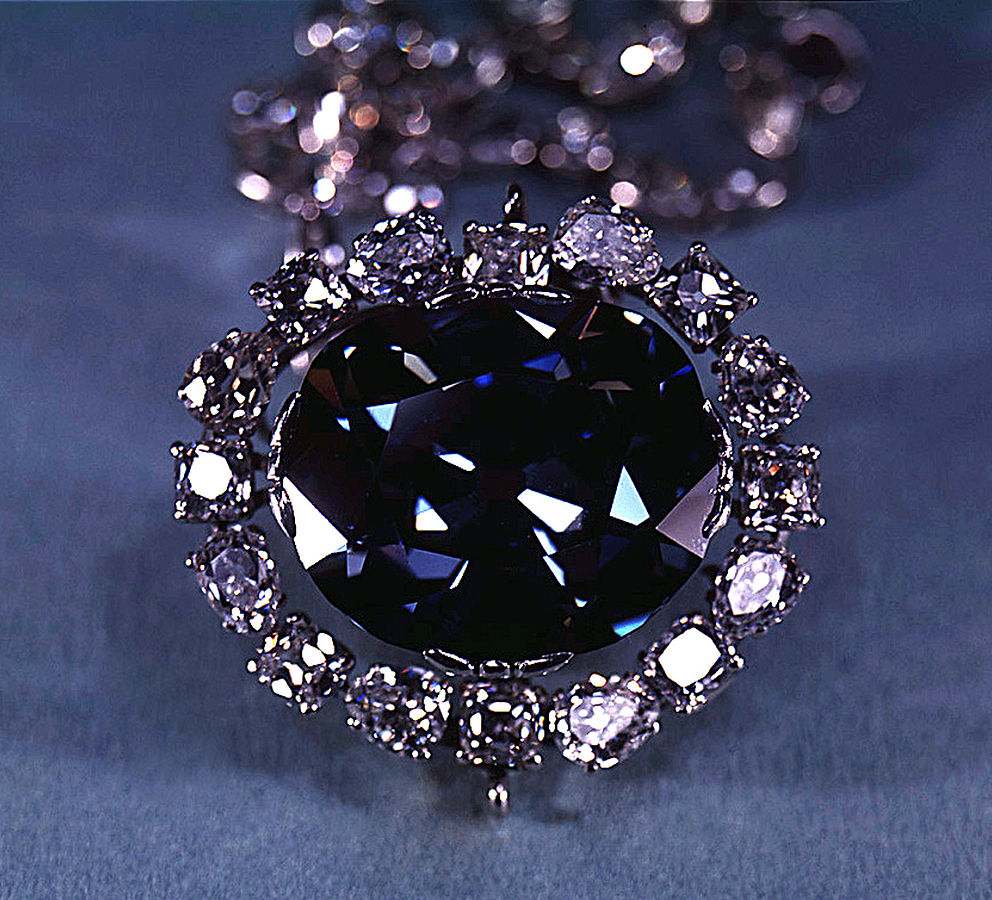
The Hope Diamond; a beautiful blue diamond weighing 45.52 carats, and perhaps the most notorious gem in history.  It was said to have a curse on because a thief stole it from the eye of a statue of the Hindu goddess, Sita. Since then the trail of unlucky owners is enough to make you believe in curses.

The Hope Diamond
1974. The Hope Diamond, one of the largest of all blue diamonds, exhibited at the National Museum of Natural History. The gem is slightly lopsided, possibly because the bottom of the teardrop shape was cut away so that the original stolen jewel could not be identified. The setting is a circlet of smaller white diamonds on a chain of diamonds. Image credit: Unknownhttp://siarchives.si.edu/collections/siris_sic_8819, Public Domain, Link

A French trader, Tavernier, bought it in India and sold it to Louis XIV, and on his very next trip to India, Tavernier was killed by wild dogs!  It was then inherited by Louis XVI and Mary Antoinette, who had their heads cut off. Shortly after their executions the diamond was stolen and was re-cut by a Dutch diamond cutter, William Fals, who died of grief after his son, Hendrik, stole the gem from him. Soon after that Hendrik committed suicide.

In 1830, the diamond (then called the French Blue), resurfaced in London. Twenty years and a day after the robbery, just when the statue of limitations on prosecution for the theft expires, Henry Hope bought it and passed it on to his nephew, Lord Francis Hope, who didn’t hold on to his wealth for very long and lost his leg in a hunting accident.  An Eastern European Prince gave it to an actress of the Folies Bergere… and later shot her.

Another owner and his family plunged to their death in a car accident. Abdul Hamid II , a Turkish sultan, owned the diamond only a few months before he was toppled from his throne in 1909.

Then there was Evelyn McLean, wife of owner of The Washington Post, who bought it from Cartier, who promised to refund her if there was a death in her family within 6 months of purchase. Her son was killed in a car accident, her husband died in a mental hospital, and her daughter committed suicide. The business started failing and she had no choice but to auction off The Washington Post. At the auction she was begging people to take the diamond in exchange for her keeping the business. Nobody wanted it and the paper was sold for small change.

The next owner, Harry Winston, mailed it with ordinary mail as a donation to the Smithsonian Institution where it has been on display ever since.

A curse?  Coincidence? Decide for yourself. But if I was offered the stone, I wouldn’t want it!

— Reinette


Goldfish Jewellery Design Studio works with all precious metals, stones and diamonds. For further information, please contact us.


Posted on

The 4C`s: How to Determine the Value of a Diamond

How to Determine the Value of a Diamond - The 4 Cs - Goldfish Jewellery Design Studio

There are several factors that determine the value of a diamond. When buying a diamond you might be surprised to find that two stones with exactly the same weight have totally different prices. The combination of colour, cut, clarity and carat weight determines the price.

THE 4 C`s

CARAT WEIGHT

The weight of a diamond is expressed in carats. One carat is equal to 0.2 grams and one carat equals 100 points.

The word “carat” comes from the use of the carob seed which was used to weigh stones and precious metals. However, this was a factual inaccuracy, as their mass varies about as much as seeds of other species.

CLARITY GRADE

All diamonds have traces of their own growth history.  In gem quality diamonds, this concerns minute internal and external characteristics, graded under Clarity.

This grade goes from FL (flawless), VVS (very very slightly included), VS (very slightly included), SI (slightly included) to I (included). Only from “I” can one see the inclusion with the naked eye.

COLOUR

Most diamonds range from slightly yellowish to colourless. The colour grade is determined by comparison with a series of master-stones. The best colour being colourless (D), then goes down the alphabet where up to the colour H still registers as white. By the colour S the stone is obviously yellow.

Diamonds come in a range of fancy colours like bright yellow, browns and black, blues, pink and even purple. The fancy blues and reds are very rare and extra expensive.

CUT

The fire, brilliancy and scintillation of a diamond are largely determined by the proportions of the various parts of the stone. This might even be the most important factor because without fire, even the most clean white diamond will look like a piece of glass.

It is also worth mentioning that there are other factors like fluorescence that can determine value of a diamond.

Then of course there is the 5th C which is the confidence of the buyer in the dealer; ensure that your jeweller has good ethics and provides you with a certificate.

— Reinette

Goldfish Jewellery Design Studio works with all precious metals, stones and diamonds. For further information, please contact us.

Posted on

Carnelian

Carnelian Jewellery - Goldfish Jewellery Design Studio

A type of chalcedony that has been used thousands of years before the birth of Christ, this semi-precious gem has been cherished and loved through the ages, and been used extensively in the jewellery industry.

Being the favourite stone of the Islamic profit Mohammed, it is not unusual to find these stones engraved with Arabic characters or even verses from the Koran. In the western world its main uses were family seals, signet rings, cameos and even scarabs.

Carnelian was believed to calm the temper and still the blood. It is used to stimulate analytical capabilities and precision, and can be used in the treatment of rheumatism, gall and kidney stones, pollen allergies and colds.

Carnelian is the ancient stone of the zodiac sign, Virgo.

The red colour of this gem is due to the presence of iron oxide, and in India they are left to bake in the sun to transform brown stones to red. Most carnelians nowadays originate from Brazil or Uruguay, and have been stained to enhance their colour.

The most interesting thing about Carnelian is most definitely its history.

In Egyptian culture, Isis uses a carnelian amulet named “Thet” to grant protection to those passing through the afterlife, and it is one of the three most powerful gems (with Turquoise and Lapis Lazuli). In Muslim culture it is referred to as “The Mecca Stone”, and those wearing this powerful gem would be granted their every desire.

One very famous Carnelian was worn by Napoleon I, Napoleon III, and Prince Imperial. It was an octagonal shaped seal and disappeared from his body after he was killed by the Zulus in South Africa, since then the stone has never been recovered.

The name carnelian is derived from the Latin word “cornum”, which means berry or cherry.  You will all be most delighted to know that it not only brings good fortune, but it is also recommended for the treatment of infertility and impotence.

–Zak


Goldfish Jewellery Design Studio works with all precious metals, stones and diamonds. For further information, please contact us.

Posted on

Zodiac Stones and Birthstones

Zodiac Stones and Birthstones - Gem stones

We are often asked about zodiac stones and birthstones, so I thought it appropriate to list them for you. However, do keep in mind that there are variations on these; through the ages many different cultures developed their own associations with different gems.  These are the most commonly accepted:

Zodiac Stones

Star SignDateGem
Aquarius20 January – 18 FebruaryGarnet
Pisces19 February – 20 MarchAmethyst
Aries21 March – 19 AprilBlood stone
Taurus20 April – 20 MaySapphire
Gemini21 May – 21 JuneAgate
Cancer22 June – 22 JulyEmerald
Leo23 July – 22 August Onyx
Virgo23 August – 22 September Carnelian
Libra23 September – 23 October Peridot
Scorpio24 October – 21 November Beryl
Sagittarius22 November – 21 DecemberTopaz
Capricorn22 December – 19 JanuaryRuby

Birthstones and Meanings

MonthGemMeaning
JanuaryGarnetConstancy
FebruaryAmethystSincerity
MarchBlood stone or AquamarineCourage
AprilDiamondInnocence
MayEmeraldLove, Success
JunePearl, moonstone, AlexandriteCompassion
JulyRubyContentment
AugustSardonyx or PeridotMarried Happiness
SeptemberSapphireClear Thinking
OctoberOpal or tourmalineHope
NovemberCitrine, TopazFidelity
DecemberTurquoise, Lapis Lazuli or TanzaniteProsperity

— Reinette

Goldfish Jewellery Design Studio works with all precious metals, stones and diamonds. For further information, please contact us.